




Fall Foodscaping with Cool Season Grains

Plant Cool-Season Grains in the Fall for Beauty, Soil Health, and a Spring Harvest
Are you like me and want a landscape that is both beautifully in bloom and bountiful with food? That is exactly what a "foodscape" provides. Foodscaping blends edible plants with ornamentals so you can have a garden that offers beauty, wildlife habitat, and something delicious to harvest, all while looking right at home in a suburban neighborhood.
Foodscaping thoughtfully incorporates plants we love to eat into the spaces where we already garden. Think of tomatoes growing next to hydrangeas, herbs tucked into perennial borders, and grains rising gracefully behind a row of flowering annuals.
Grains fit right into the goals of foodscaping! I discovered grains more than a decade ago when a friend handed me a bag of wheat seeds. I had no experience growing traditional agricultural crops, but I was immediately fascinated by the idea of incorporating grains into my suburban landscape. That experiment quickly turned into a year-round obsession and earned me the nickname "Crazy Grain Lady!"
I use "fall grains" and "cool-season grains" interchangeably. They mean the same thing: grains planted in the fall that thrive during the cool months ahead. Fall is the perfect time to experiment with cool-season grains, particularly in the South. Wheat, oats, barley, and rye can be sown in fall and will establish roots all winter. As temperatures warm in early spring, they shoot up fast, then flower, and you harvest the seed in spring or summer.
Why Grow Cool-Season Grains in a Foodscape?
Grains are the seeds of plants in the grass family, Poaceae, including all the proper cereal crops: wheat, oats, barley, rye, corn, millet, rice, and sorghum. Grains are an essential food crop around the world, but they also have tremendous value as landscape plants.
Their upright growth adds texture and movement to a garden, while their seed heads provide food for birds and other wildlife, as well as for ambitious gardeners who want to go above and beyond! Grains also produce an impressive amount of biomass, making them useful plants for improving soil in garden beds.
Start Cool-Season Grains with Great Soil
Before scattering a single seed, take some time to prepare your planting beds. This is especially important in foodscaping because the same bed may be supporting grains, flowers, vegetables, and other ornamental perennials, trees, and shrubs throughout the year.
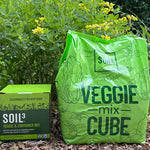
I like to begin by incorporating Soil³ organic compost into new beds or adding it as a top layer to established garden areas. This compost adds organic matter and helps improve soil structure, water-holding capacity, and nutrient availability. This is particularly valuable in sandy soils that drain quickly, as well as heavier soils that need better structure.
For me, compost is the foundation of successful foodscaping. I've used Soil³ for more than a decade, and it's become an essential tool in my garden. Building healthy soil before planting gives seedlings the conditions they need to establish strong roots and sets the stage for everything that follows.
Once your bed is prepared, simply sow your grain according to the recommended planting rate and keep the seedbed consistently moist until germination.
Sow cool-season grains directly into a bed of Soil³ compost.
You don't need an entire bed dedicated to grains. Try sowing a narrow strip along the back of a border or planting small clumps among ornamental plants to look like an ornamental grass!
Clumps of barley look like ornamental grass.
Cool-Season Grains for Fall Foodscaping
Wheat is one of my favorite choices because it combines productivity with ornamental appeal. The soft green foliage looks beautiful in winter, and the golden seed heads create an entirely different display as they mature. Turkey Red is a great choice for southern gardeners as it has good structural integrity, and the seed is easy to harvest and grind into flour.

Rye is another excellent choice, particularly when improving soil is part of the goal. Its extensive root system helps hold soil in place and capture nutrients.

Oats establish quickly and have a graceful, open appearance that works surprisingly well in ornamental combinations. Birds especially adore oat seed, so consider this to be living bird food!

Barley is the beauty queen of the grain world, producing distinctive seed heads and adding a strong vertical element to borders. Of course you can’t have beer without barley, so if you are into brewing, this is a must-grow!

Pair Fall Grains with Spring Blooming Flowers
One of the most exciting things about fall-planted grains is that they overlap beautifully with spring-blooming annuals.
As wheat, oats, barley, and rye grow taller, they can provide a soft backdrop for flowers such as larkspur, poppies, nigella, bachelor buttons, calendula, and snapdragons. These combinations create the relaxed, layered look that makes a cottage garden so appealing.
The grain provides structure while the flowers add color. Once the flowers fade, the grain continues developing toward its spring or summer harvest.
This is foodscaping at its best: plants perform multiple jobs while creating a landscape that changes throughout the seasons and provides an abundant harvest!
Poppies and wheat are a relaxed, layered combination.
Cool-Season Grains as Soil-Building Plants
One reason I keep growing grains is their contribution to soil health.
Cool-season grains are excellent cover crops, producing substantial root and above-ground biomass. They develop deep root systems, which act as nutrient scavengers, drawing essential elements up to the surface to provide nitrogen, phosphorus, and potassium for other plants! These roots also act as literal rototillers, creating channels for organic matter to flow through, thus breaking up compacted soil.
As the plants grow, their roots explore the soil and capture nutrients. When the plants are cut back, the roots and cut-back biomass can be left there to return to the soil as organic material. Over time, this cycle can help build soil structure and increase biological activity. This action makes grains particularly useful when you are trying to transition an underperforming area into a productive garden.
Try Fall Foodscaping with Grains
If you have a sunny garden bed that could use some winter interest, consider sowing grains this fall. You don't need acres of land or specialized equipment. A small patch of wheat, oats, barley, or rye can provide an entirely new dimension to your landscape.
Prepare the bed with Soil³ organic compost, direct-sow the seeds, add some colorful spring flowers, and let nature do much of the work while you watch everything grow! By spring, you'll have a garden that is beautiful, productive, and actively building the foundation for the next growing season. That is the magic of foodscaping: cultivating a beautiful, bountiful space!

One of my favorite ways to take foodscaping to another level is by growing grains, which is why I wrote a book on the subject! Check out Gardening with Grains for an in-depth guide to cultivating these essential food sources in creative ways.
If you enjoy learning with videos, my entire grains playlist can be viewed on YouTube here: Gardening with Grains.
Happy Gardening,
Brie the Plant Lady


